
Girl with a Pearl Earring: Looking, Simplicity, and the Power of Restraint
Girl with a Pearl Earring: Looking, Simplicity, and the Power of Restraint
There are paintings that tell stories, and others that do something quieter. Johannes Vermeer’s Girl with a Pearl Earring belongs firmly to the second group. It does not describe an event, it does not present a narrative, and it does not rely on context. And yet, it holds attention in a way that few images manage to do.
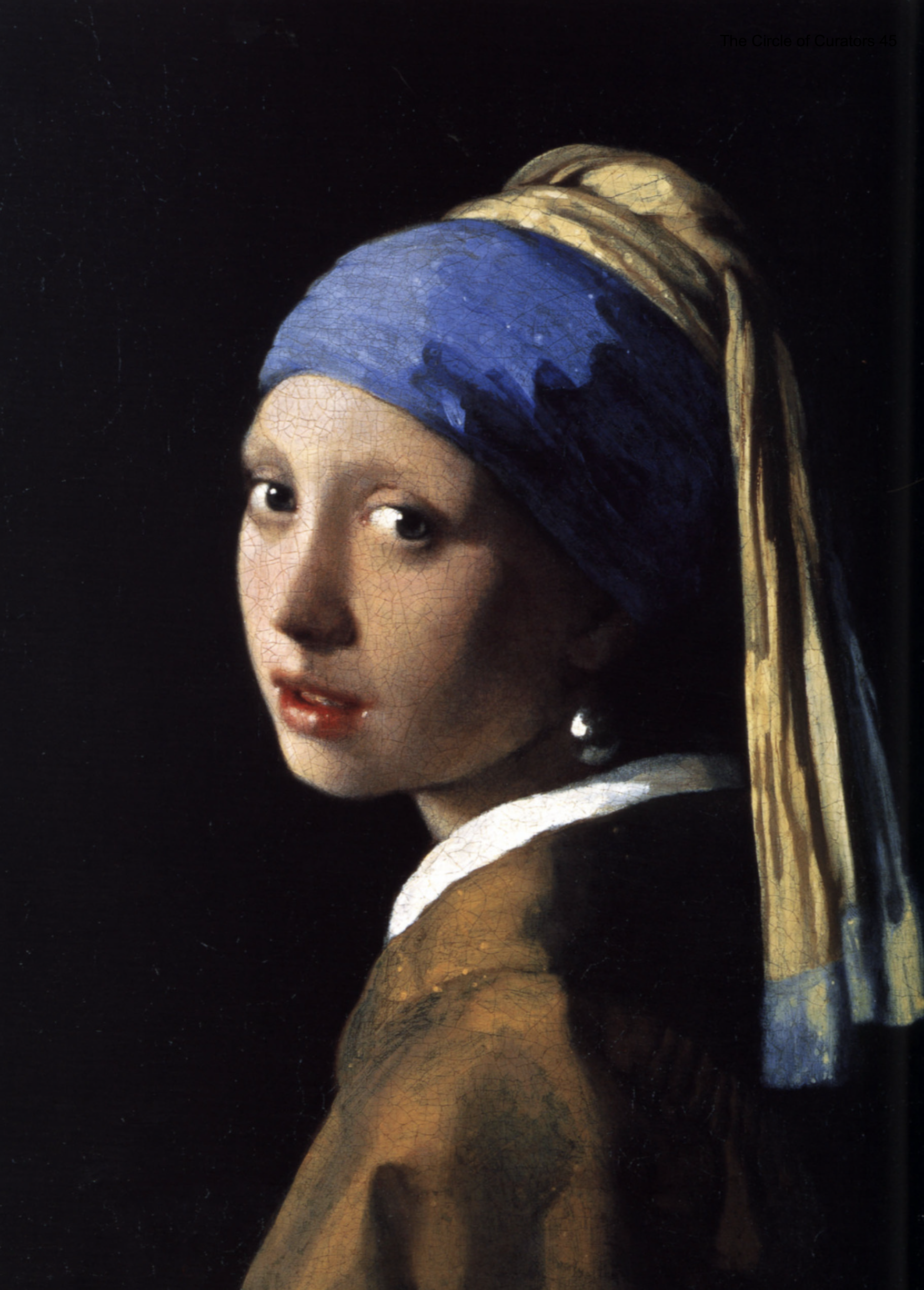
At first glance, the composition could not be simpler. A young girl turns her head slightly towards the viewer. Her lips are parted, her gaze direct but not confrontational. She wears a blue and yellow headscarf, and a large pearl earring catches the light. Behind her, there is no background at all — just a dark, empty space.
Nothing distracts from the figure. There is no setting, no furniture, no additional elements to interpret. Everything has been reduced to the essentials.
Although often referred to as a portrait, this painting does not function like one. We do not know who the girl is, and that lack of identity is important. Traditional portraiture tends to anchor a subject within a social or historical context — someone with a name, a role, a place in the world.
Here, none of that exists. The figure is anonymous, and that shifts the focus entirely. Instead of asking who she is, we are left with a different question: what exactly are we looking at?
Vermeer is not documenting a person. He is constructing an image. This distinction may seem subtle, but it changes the way the painting operates. The girl is not presented as an individual with a story. She is presented as a presence — something immediate, almost suspended.
One of the most striking aspects of the painting is how controlled it feels. Vermeer’s use of light is precise, but never exaggerated. It falls softly across the girl’s face, revealing just enough detail without overdefining anything.
There are no harsh contrasts. The transitions between light and shadow are gradual, almost seamless. This gives the painting a sense of calm, but also of focus. Nothing feels accidental.
The pearl itself is a good example of this restraint. It is not rendered with intricate detail. In fact, it is barely described at all — just a few highlights suggesting its form. What matters is not its physical accuracy, but the way it reflects light.
In that sense, the painting is less about objects and more about perception. It shows how things appear, rather than what they are.
There is also a subtle sense of movement in the painting, but it is extremely minimal. The girl appears to have just turned her head. It is not a dramatic gesture, but it is enough to create a feeling of immediacy.
At the same time, the moment feels incomplete. We are not told what caused her to turn, or what she is reacting to. There is no before and no after — only this single, suspended instant.
This lack of context is not a limitation. It is part of what gives the image its strength. By removing narrative, Vermeer avoids fixing the meaning of the painting. Instead, he leaves space for interpretation, without forcing it.
One of the reasons the painting feels so direct is the way it engages with the viewer. The girl’s gaze is not vague or distant. It is clearly directed outward, establishing a connection.
But it is not an aggressive or confrontational look. There is a softness to it, a kind of openness. The slightly parted lips reinforce this impression, as if she is about to speak, or has just been interrupted.
This creates a subtle tension. The painting feels intimate, but also closed. We are invited to look, but not to fully understand. There is no access beyond what is visible.
What stands out most, especially when compared to other paintings of the same period, is how restrained everything is. There is no excess, no decorative complexity, no attempt to impress through scale or narrative.
Every element serves a purpose. The composition is tight, the colour palette limited, the background reduced to almost nothing.
This level of control is not restrictive — it is what allows the painting to work. By removing anything unnecessary, Vermeer directs all attention to the essentials: light, form, and the act of looking. It is a quiet kind of confidence.
Although the painting dates from the seventeenth century, it does not feel tied to its time. In many ways, it feels closer to modern sensibilities than to the traditions of its own period.
There is no need for historical knowledge to engage with it. It does not rely on symbolism or narrative complexity. Its impact is immediate and visual.
That is part of why it continues to be so widely reproduced and recognised. It works at a distance, but it also holds up under close attention. The more you look, the less it tries to explain itself.
Like many of the strongest works of art, Girl with a Pearl Earring does not offer a clear conclusion. It does not guide the viewer towards a single interpretation, nor does it attempt to resolve its own ambiguity.
Instead, it remains open.
The figure does not move, the expression does not change, and the situation is never clarified. The painting stays exactly as it is, regardless of how long you look at it.
And yet, it does not become static or empty. It continues to hold attention, precisely because it does not close. There is always the sense that something could be understood more fully — but never quite is.
#JohannesVermeer #GirlWithAPearlEarring #ArtHistory #Painting #DutchGoldenAge #ClassicalArt #ArtEssay #VisualCulture #OldMasters #ContemporaryLooking #MuseumArt #ArtWriting #Vermeer #FineArt #PaintingAnalysis